
Meet Leslie Lisbona
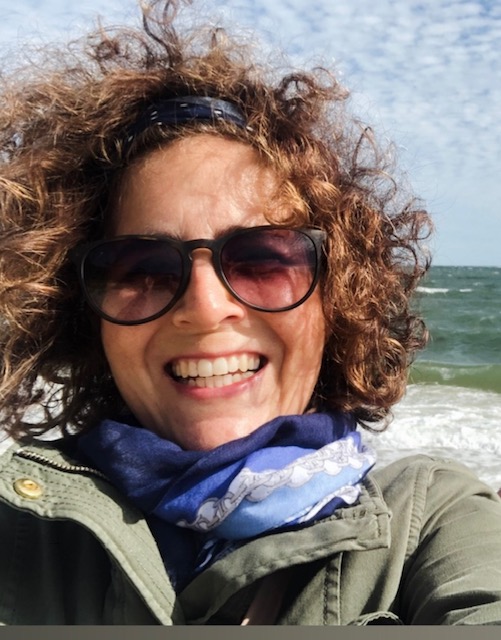
Leslie Lisbona has been published in various literary journals, most recently in Wrong Turn Lit, The Bluebird Word, and Dorothy Parker’s Ashes. She was featured in the New York Times Style Section 3/24. She is the child of immigrants from Beirut, Lebanon, and grew up in Queens, NY.
Leslie Lisbona’s writing is effortless. While authors often lay out collections of nonfiction like they’re guiding you through stale museums of memory, Lisbona grabs you by the hand and runs with you through hers. Daring enough to indulge in nostalgia and embrace emotion, but too light on her feet to fall into sentimentality, Lisbona’s works are introspective portraits of subtle complexities. Reading through her work feels like reliving shared experiences with a first love.
Follow the links below to read Leslie’s nonfiction!
Regine’s
Red Light Green Light
Loitering
Good Grief
Fiorucci
Cruel Summer
Monsieur Lisbona
Flying
Leslie was kind enough to answer a few questions for us. Please enjoy.
What is a writer to you?
A writer is someone who invites you in, who takes you by the hand and lets you accompany them on a journey, maybe bearing witness, possibly making them feel less alone. It is someone who cares about their craft, finding the right words, refining their work, and creating a piece that resonates. I like writing that is evocative of a time and place. I find that I fall a little bit in love with a good author. Once I went to a reading at the 92nd Street Y. Elie Weisel was speaking. I waited for him at the end so he could sign my French copy of The Night. I was so overcome when he shook my hand that instead of saying “I love your work”, I blurted out: “I love you”. I felt foolish but then I thought that I did love him, as I loved Milan Kundera, Edith Wharton, Andre Aciman, Art Spiegelman, Meg Wollitzer, Jumpa Lahiri, and Paul Auster.
When did you realize you were a writer?
I always dreamed of being a writer but I never thought it was possible for me. I majored in economics to please my father and then worked in banking for twenty years before I stepped into Susan Hodara’s writing class at the Hudson Valley Writers Center. I went at night, after working all day and taking care of two children. It took me over ten years to submit something and several more for anything to be accepted for publication. In a year and a half 37 personal essays have been published. At 59, I have become a writer.
What are your (big or small) goals as a writer?
My goal is to get more personal essays published. I would like to be accepted by Modern Love in the NYTimes or Readers Write in The Sun. Loftier goals include The New Yorker.
Describe your writing routine or lack thereof, and where you typically find inspiration. Can you share specific places or situations where you’ve conceived or written your poems?
I read a lot. I don’t go anywhere without a book. I can’t sleep without reading, even for a few minutes. Reading makes me want to write. I’m continually inspired by Dani Shapiro, Lena Dunham, JoAnne Beard, Sloane Crosley, and Elizabeth Strout.
What is your relationship to writing like? Do you love it? Hate it? Do you think your art comes from within you or do you believe in muses, or a divine spirit that uses you as an antenna?
My biggest inspiration is from other authors. I just finished a book by Hisham Matar called The Return. This is the kind of work that I could read twice, just to hear his words ring in my head. I had the same feeling with The Known World by Edward P. Jones.
Inspiration strikes whenever it wants, wherever you are. Can you list some of the places you were at when you either conceived of these poems or actually wrote them?
I get most of my ideas when I wake up in the morning. Everything seems so clear which is odd because I am not a morning person. Other times, when I’m walking my black lab, Rhoda, in the woods near my house.
What is the most detrimental to your writing progress? (E.g., Is it distractions? Plotting? Revisions? The blank page? The finishing? The size of your audience?)
The most detrimental thing that happened to me, writing wise, was that I had given my manuscript to fellow student who graciously offered to read it for me. I waited weeks for a response. One day I opened an email from her that had one question: Was English my second language? I never wanted to write again. I realized a short while later that she was just one person, that I needed a tougher skin, that writing is so subjective.
If you could provide an accompanying soundtrack to your work, what songs would you include on it?
Friday I’m in Love by the Cure, Never Let me Down Again by Depeche Mode, Ring My Bell by Anita Ward, Your Wildest Dreams by the Moody Blues, Formidable by Charles Aznavour, Don’t Leave Me This Way by Thelma Houston, The Highwayman by Willie Nelson, Johnny Cash, Waylon Jennings and Kris Kristofferson.
If your collection manifested into human form, what would your first date be like?
My first date of this manifestation would be kaleidoscopic, holding on tight on the back of a motorcycle on a hot summer night, eating a shawarma in the East Village and I would never want it to end.
If your collection does manifest into human form, give us a day in their life, some backstory for them, and what’s in store for them.
If this were to take on a human form, he or she is a foreigner, enveloped in their adopted city, carrying their old world with them in a slight accent that only some people can detect. Their vulnerability would make them lovable.
We all have strengths and weaknesses in our writing, what are yours?
I’m not afraid of an awful first draft.
What deal would you make with the devil? (Does not have pertain to writing.)
I’ve made so many deals already. I’m not sure they work.
What is one thing you would change about the literary community/industry?
I don’t know enough about it yet. I published my first piece in January 2023 and so far, the community/industry has been kind to me.
What written work by another author lives rent-free in your head?
The House of Mirth by Edith Wharton. Lilly Bart comes to mind, especially when I’m running through Grand Central Station in NYC.
What are your three desert island books? You’re allowed a guilty pleasure too.
Anything by Paul Auster. I love the New York Trilogy and Timbuktu. Same is true for Elizabeth Strout. Olive Kittredge and My Name is Lucy Barton. The Known World by Edward P. Jones is a masterpiece that I just recently discovered.
Anything by Nora Ephron, and the September issue of Vogue.
Tell us about the inspiration behind your work on BarBar.
My first piece for BarBar “Flying”, was for the Sweat issue. I wanted to write about the pure mechanics of my body, what it could do for me, moving me through space at a speed that was exhilarating and freeing. In “Red Light Green Light” was about going to school at P.S. 99. I couldn’t figure out, at age 6, when it was time for me to cross the street. Was the light green for me or the cars? It was a miracle I survived. With “Regine’s” I wanted to capture being sixteen, on the cusp of being a grown up, dancing with my best friend in NYC.
“Loitering” was inspired by my brother, 14 years my senior. I’m a city girl from Queens, NY and I went camping with my brother and our families in Oregon. My brother and I felt useless and out of place, not knowing how to build the tent or make a fire. In the middle of the night, I was seized by a panic attack. My brother managed to comfort me and I realized that he was having a panic attack as well. In “Good Grief” I wanted to write about a sliver of a moment that brought me to my knees. I had let my dog out in my fenced in backyard. After I called to her and she didn’t respond, I saw that the gate was open and a truck rumbled down my busy street. I screamed for her. In that moment, I felt all was lost. I was devastated. Ten seconds later or maybe one second, she was by my side but it took me the rest of the afternoon to recover.
Tell us about the process of creating, finishing, and submitting the work published on BarBar.
I usually go through many drafts. I read them to my writing group, 6 other people who I trust. I like to read my work out loud. I get to hear where it goes wrong and when it sounds right, like a melody or a pattern or a rhythm. I like to use dialogue, when I can, to flesh out my characters, their idiosyncrasies and things they do that are unique to them. When I think I’m done with the writing, I leave it alone for a few days. If after that time, I have nothing left to add or remove, I submit it. BarBar is a great home for my work, like finding a friend that you don’t have to explain too much to.
Tell us about the projects you are working on now and what’s next.
I’m working on a memoir. Stand Clear of the Closing Doors is nearly complete. We were a close-knit Jewish family, speaking French and Arabic, our Arab and Levantine roots intertwined with the ethos of the 1970’s and 1980’s New York City around us. The chapters will be made up of 20 pairings, two personal essays linked by some sensibility or object. The stories will be connected through space and time from my beginnings in Queens, NY, in a cramped apartment with my much older siblings and my immigrant parents to the present day, some 55 years later, with my husband and two grown sons. There are definitely unique challenges that are explored in my book. I’m looking for an agent at the moment.
All my essays can be found on leslielisbona.substack.com. It’s free to subscribe.
 BarBar