
Meet Allison Goldstein
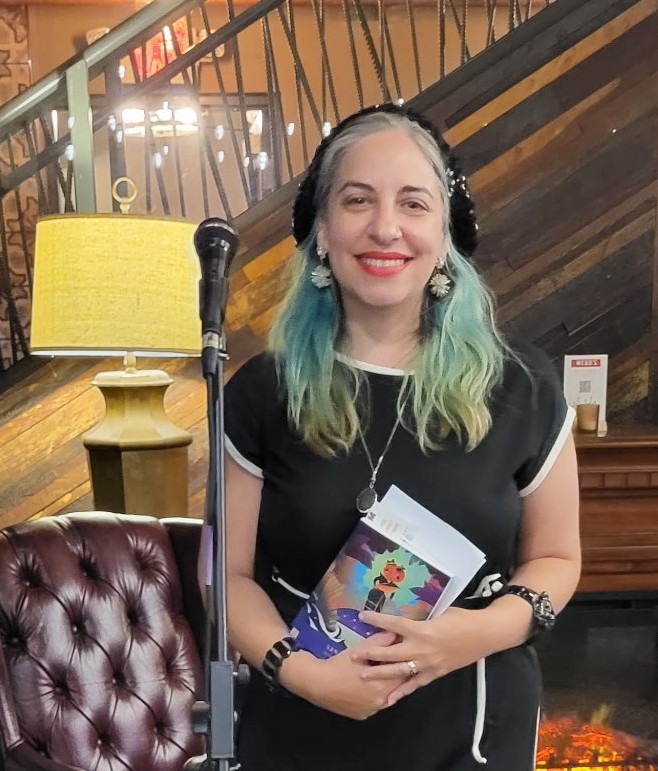
Allison Goldstein is a poet, writer, and visual artist. She received her MFA in Poetry from California College of the Arts. Her horror movie-themed poetry chapbook, “In The Night, In The Dark” was released by Bottlecap Press in 2025. Her work has also appeared in a variety of literary and cultural publications including Not Very Quiet: The Anthology, Saw Palm, Gyroscope Review, Last Girls Club, and Maximum Rocknroll. Allison currently lives and writes in South Florida.
Allison Goldstein is not afraid. Playing in the shadows of the greatest horror films of the 20th century, her debut chapbook, In The Night, In The Dark, reimagines these nightmare-makers as meditative expeditions into the hauntings of the human heart. With the lyrical grace of a Black Lagoon ballet, these poetic exorcisms are as haunting as they are beautiful.
Allison’s horror themed chapbook In The Night, In The Dark is now availble through Bottlecap Press.
Read a sample poem from Allison’s debut chapbook here:
Carnival of Souls – Muted
Learn more about Allison and pick up your copy of In The Night, In The Dark by following the links below:
Allisongoldsteinpoetry.com
@excuse_me_theres_a_cat
Bottlecap Press
Allison was kind enough to answer a few questions for us. Please enjoy.
What was the initial seed for In The Night, In The Dark—was it a single poem, a recurring image, or a feeling you couldn’t shake?
I’ve loved horror since I was a kid, but my previous horror writing was generally essays and opinion pieces. A few Octobers ago, I was three movies deep into a Universal Monsters marathon in my living room when I started jotting down some notes. Within an hour, those notes became ‘The Mummy (1932)’ and then everything just clicked. I became enamored with the idea of writing an entire poetry collection about horror movies and the real fears they represent. Since I have a large horror background to draw from, the initial concepts flowed pretty easily and that created a lot of momentum to get the project up and running.
Did you find a unifying theme emerging naturally across the poems, or did you shape the collection with a specific emotional or conceptual arc in mind?
I envisioned the poems as a short meditation on each film, honing in on a larger trope or a lingering moment and then diving in. In that way the poems are very much their own, but connected by a similar approach beyond the overall horror theme.
I’m also very interested in how horror both critiques and plays into ideas about womanhood, motherhood, sexuality, sexual availability, and who is seen as a victim vs. who is labeled a villain. The way horror films handle gender expectations and their broader cultural impact all play into how I approached the poems as a collection.
Are there particular images, settings, or emotional tones that you found yourself returning to in the chapbook? What do they mean to you?
I’m a visual person and I think that shows in the poems. Film and poetry both rely heavily on images and metaphor to reveal truths or explore trauma. I think I’m particularly drawn to themes of identity and isolation, which are abundant in horror, as well as how fear manifests itself physically. I feel like I’m always writing about hands, shadows, and bodies.
How did you decide what belonged in In The Night, In The Dark versus what didn’t—what was your internal compass during that curation process?
After a few weeks of sketching out poem drafts for the book, I decided to narrow my focus to 20th century horror. There’s something really special about that first full century of film, and how those themes tapped into the cultural zeitgeist of the time while creating the foundation for modern horror. It also leaves room to potentially write a sequel book one day that focuses on more recent films.
Did any poem in the collection surprise you by taking on more significance than expected?
I never had the intention to include more than one poem about the same movie in the final collection. Many of the poems started out as a series of drafts exploring specific ideas or iconography I was interested in. During the editing process I’d abandon or revise the drafts until I got to the single poem that resonated with me the most. With ‘Carnival of Souls’ the two poems that survived that editing process felt so different in their focus and tone that I couldn’t really choose between them and decided there was enough merit to keep both, which is how Carnival of Souls – Muted, and Carnival of Souls – Release both made their way into the chapbook.
What did you learn—about yourself or your writing—while putting together In The Night, In The Dark?
It’s really difficult to write in a vacuum, you need feedback. I worked on these poems for a very long time on my own and was delighted when I had the opportunity to get some fresh eyes on them and real feedback about what was working and what concepts weren’t quite there yet. That’s really when I was able to mold the poems into something that felt like a purposeful collection. When you’re too close to the work, it’s hard to see those moments.
Was there a moment during the making of this chapbook where you nearly gave up? How did you move through that?
There were multiple times throughout the process when I wondered if there was an audience for this work besides me. I know there are a lot of horror fans out there and poetry lovers, but I was unsure about how many people were interested in enjoying both simultaneously. Eventually, I decided it didn’t matter. I wanted to write this book and I wrote this book. I do believe there is an audience for horror movie poetry – but either way, I’m really excited about how the project turned out. It felt very organic to my interests and my perspective as a poet.
How does this chapbook reflect your current creative obsessions or preoccupations? Does it feel like a culmination, a departure, or something else?
I knew if I wanted to write a collection, I needed to start with an obsession – something I could write a lot about and then sharpen to a fine edge. Horror movies definitely fit that bill for me. While I believe the poems are a culmination of decades of watching and loving horror, my writing style has definitely evolved over time. I think if I wrote these poems 20 years ago the themes would be similar, but the format and narrative approach would be very different.
What kind of conversations—or silences—do you hope readers bring to or leave with after reading this book?
Just like revisiting a film, I hope readers get an initial enjoyment out of experiencing the poems and can then come back and find something new in them with subsequent readings. At the very least, I hope that the poems inspire the reader to consider their own thoughts and relationships with these films.
Now that In The Night, In The Dark is finished, what’s next for you creatively?
I have another chapbook that I’m trying to get out into the world that is a reimaging of the Pandora myth from her perspective, but I’m also working on my first full length poetry collection, which is scary and exciting in a different way.
What personal experiences or memories do you feel haunt the edges of In The Night, In The Dark, even if they aren’t named outright?
My father, who passed away about 15 years ago, was instrumental in developing my love of film and especially horror. We spent a lot of weekends either going to the movies or renting VHS tapes when I was a kid. He also didn’t care about MPA ratings, so we were watching everything from Alien to The Toxic Avenger before I was 10 and I couldn’t get enough. I do think part of this project was subconsciously about reconnecting with my father through that shared love of horror. All those memories are intertwined with the poems, even though none of the poems are about him.
Have chapbooks always appealed to you as a form? What do you think they allow that longer works sometimes don’t?
I enjoy the beauty and brevity of chapbooks. Not every concept needs 80 pages of poetry to make it feel complete. Chapbooks are these lovely self-contained planets. They don’t over-explain themselves, and the individual poems don’t have to fight for attention the way they tend to do in larger works. I think I like chapbooks for the same reason I like sonnets. There’s a form and an expectation, but just as many ways to subvert those expectations and create something wildly your own. Navigating imposed limitations can also keep the work more focused and sometimes more powerful.
Do you write poems knowing they’ll one day become part of a collection, or does the idea of a chapbook come later?
As a professional copywriter, it’s often difficult for me to find the time and energy to focus on my own creative work. Over the years, my personal writing process became sporadic and only reflected whatever was buzzing around inside me at the time. This created a lot of honest but unconnected work. I knew if I wanted to publish a collection instead of individual poems, I had to sit down and purposely write a collection.
Writing this chapbook was 100% intentional and definitely outside my wheelhouse, but I found the process very satisfying.
When a poem in the collection wasn’t quite working, how did you know whether to revise it, replace it, or let it go?
Making final decisions about what to keep and not keep was heart wrenching. If I felt really strongly about the overall concept for a poem and at least some of the images, I kept revising. When I couldn’t get those parts to connect, I would try going in a different direction and start a new draft. Overall, it was a good system, but it didn’t always work. There were several movies I really wanted to include, but just couldn’t get the poem right, including Carrie, Tod Browning’s Freaks, and Rosemary’s Baby. I have at least seven drafts for Carrie and none of them are great. At a certain point, I didn’t want to hold the whole project hostage and had to let it go. That said, I am determined to one day finish the Carrie poem.
 BarBar