
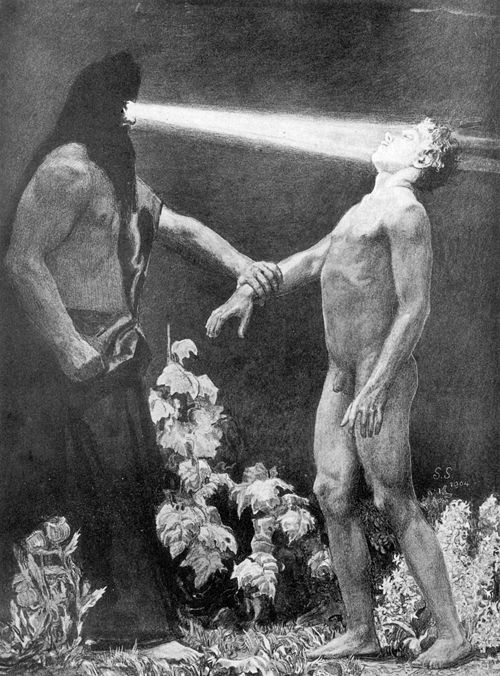
I: Present
Luna Bien wakes up alone on a beach. The sky is cloudy, like a movie scene where the villain challenges the hero to a duel. Sand fills the spaces between her toes. She walks to an ancient stone monastery. It’s eroding after years of abandonment. She runs her fingers through her hair, feeling the sea salt crusting it. She pulls the wooden door, barely held together by two rusted hinges. She tries not to rip it from the wall. Inside the monastery, a bench faces an altar covered in candle stubs dripping hardened wax frozen in time. Luna imagines the lives within these walls. When she sees their faces, huge, black block letters appear, reading, “This is not included in your subscription.” The words jolt her back to reality, where she is still plugged into the Dream Machine inside her jail cell. She always hated nature dreams. They kept her from bleak nothingness but didn’t contribute any symbolic importance to dream theory.
II: Childhood
Luna’s fascination with dreaming started when she was just a child. She spent her days wandering around her massive backyard. It resembled a forest with large pine trees and a rushing creek, then one seen in catalogs with mass-manufactured playsets. She remembered her dreams from the previous night as she walked, recognizing each person. Her dreams often featured the same people in different scenarios. Her favorite was a boy ten years older than her, with messy dark brown hair, wearing a cable knit sweater and corduroy pants. She felt a special connection to him. She hoped they would meet in real life.
While slaying dragons, they shared their hopes and fears. Luna felt she knew him better than anyone in her waking life. He shared his aspirations to escape his small town and change the world. He wasn’t sure how to do it, but he wanted his name to be remembered in history textbooks. Luna didn’t care about fame. She only wanted to escape the recurring nightmare that cursed her every night they were apart.
As Luna grew up, the boy appeared less frequently in her dreams. She thought it was because they were growing out of their childhood wonder and into more adult dreams involving depraved hellscapes and twisted fantasies. He would sometimes make guest appearances, but now they were just strangers. His picture faded from her memory. She questioned whether she would recognize him if they ever met. By the time Luna was a teenager, she had forgotten about him and her love for dreaming.
III: University
Luna’s infatuation with dreaming was reinvigorated in her first year of university. In her Psychology 101 class, Professor Van Winkle wrote “DREAMS” on the chalkboard. He then told his students they would share their most recent dreams for their first assignment. She reminisced about how much she enjoyed dreaming as a young child.
The day arrived for everyone to share their dreams. Her peers had normal dreams like being naked at school, failing a test, or other mundane memories. But Luna’s dreams were sadistic wonderlands similar to a Hieronymus Bosch painting. She horrified her classmates as she told them about the drug-filled orgies she had on top of mountains of recently decapitated heads caused by a recent battle with evil robotic galactic octopi. Instead of sending her to the Dean’s office for a psychological evaluation, Professor Van Winkle used Luna’s dreams as an opportunity to teach the class about dream theory. She became fascinated with the different interpretations of dreams. He ended his lecture by declaring that many reasons people dream are still unknown. This spurred Luna to become the dream psychologist who would develop the next grand theory.
When Luna declared her major, Professor Van Winkle became her advisor. He made a name for himself in the dream psychology community years prior when he determined how to alter dreams with his student researcher, Jacques Frère. Jacques used this knowledge to start his company, Dream Corps, the leading innovator in holistic dream synergy. They were shifting the paradigms of big data to create cutting-edge, consumer-driven initiatives. Recently, Dream Corps announced its new technology to inject ads into dreams. When this practice was first announced, Luna was furious. She could do nothing because the Supreme Court ruled companies had the right to freely express their voices, even subconsciously. Over time, people became accustomed to having their dreams interrupted by plaque-preventing toothpaste commercials and corporate animations of happy families shopping at grocery stores.
Luna focused her research on the ethics of changing dreams. As the first person to consider this, she became the leading expert. Her Ph.D. thesis concluded that alteration should only be allowed when dreamers consent. Technically, everyone agreed because it was in the microscopic print put into all the terms and conditions agreements that no one ever read. After a thorough cost-benefit analysis, Luna decided that, in many cases, altering dreams could alleviate sleep and psychological disorders. When Luna graduated, she received numerous offers for tenure-track positions. However, she wanted to work at Dream Corps to ensure their control over dreams remained ethical.
IV: Dream Corps
Professor Van Winkle introduced Luna to Jacques. He agreed that the company should have an ethics department, especially if it faced legal trouble. He was impressed with her research on dream alteration ethics and invited her to head the department. Her first assignment was to initiate Dream Corp’s new project, Dream Stream. This project recorded people’s dreams as movies and sold them to streaming services. She was excited by this new idea. Researchers could more accurately study dreams when the subconscious was available to the public.
Luna was the first to test to ensure Dream Stream was safe. The dream scientists attached a narrow band around her head that transferred her dream into a recording device that could be streamed and stored in the Dream Corps archive. As she fell asleep, she slipped into the recurring nightmare she had since childhood. When the dream concluded, the scientists woke her and told her they captured it. They played her dream back, and she winced as she watched it. She green-lit the new project as long as all who had their dreams streamed signed an extensive waiver with full consent.
When she wasn’t busy running the Ethics Department, Luna was observing new projects. She was intrigued by the technology and the dreams the public was interested in viewing. She realized that the more depraved a dream, the greater the number of people who wanted to watch it. The subjects, considered good, moral people, often had the worst dreams. Luna recently read Victor Sandman’s case file. He bragged about being a vegan and a lifetime member of the ACLU. However, he dreamed about a cult that believed the only way to create a perfect utopia was to purge the Earth of anyone who committed any of the seven deadly sins. He soon became a celebrity based on the popularity of his decadently debauched dreams.
As dream streaming became the most popular form of media, people started noticing themselves in others’ dreams. They became angry because they didn’t consent to such actions. This provoked nationwide protests. Debates arose in every household, and newscasters were quick to cover it. Victor Sandman became the face of Dream Corps. He went live on talk shows advocating for dream streaming to continue, assuring the audience that everything on TV was fictional. The people who looked like them were only subconscious projections.
The ethical dilemma of consent in dreams started to weigh Luna down. She scolded herself for not considering that every person who appears in dreams is someone the dreamer has seen in real life. Her interest in the technology and its potential impact clouded her judgment. She questioned her role in making this possible. She felt mocked by the smiling face of Victor Sandman on billboards with text reading, “Don’t believe it! Stream it!” with tiny lettering underneath: “Sponsored by Dream Corps: The Company Making Your Dreams a Reality.”
The protests became more extreme. People refused to sleep. They didn’t want to harm people in their subconscious. The streets became filled with zombies with large dark circles under their eyes who would rather face death than close their eyes. Watching more people die every day from sleep deprivation motivated Luna to quit. She hoped that leaving would make Dream Corps abandon Dream Stream. She submitted her two-week notice in an email to Jacques. He immediately replied, asking to see her in his office. Going into the meeting, Luna knew Jacques would try to convince her to stay by saying she was an irreplaceable asset. Still, she held her ground to show the public that the Ethics Department no longer supported the corporation.
“Hello, Luna,” he said, “Please take a seat.”
Luna sat in the rolling chair across from him. “No matter what you say, I’m still quitting,” she told him, getting straight to the point.
He leaned forward so close she smelled his breath. “What I’m about to tell you is confidential,” he paused. “But I’m sharing it with you because I hope you’ll help me. I figured out a way to dream ethically again.”
“But that’s not possible. Any time we dream, it’s unethical because of the lack of consent in dreams,” she objected.
“Yes, however, I found a loophole. The researchers have been working on a project where people will plug themselves into Dream Machines with different dream scenarios filmed here.”
“How will you convince people to use the machines?”
“I could give you the boring details from my meetings with politicians, but it’ll be announced in the next few weeks that dreaming is illegal.”
“So, there will be no more dreaming,” Luna said in shock, “but that’s impossible. You can’t prevent people from dreaming.”
“It’s easier than you think. Thanks to our tech department, I now have eyes everywhere. Our technology has become so advanced we can see into anyone’s brain and monitor when they are sleeping.”
“But isn’t that an invasion of privacy?”
“Not when it’s for the greater good.” As Jacques responded, the world crumbled. She was horrified by a world without dreams and the possibility that the time she spent studying them was for nothing.
“Now that dreaming will be completely ethical,” he continued, “there will be no need for your department. I wanted to offer you a job as a scriptwriter for dream scenarios.”
“No, I’m a dream scientist, not a mindless Hollywood wannabee. How dare you think so low of me. Screw you and this company,” she yelled. She left his office, knowing she had no future at Dream Corps. Other scientists were soon fired and replaced by actors and producers. When Luna left the office with all her belongings, she hoped the public would take note that Dream Corp’s actions were no longer ethical. However, only HR and Jacques knew she had left, and the Ethics Department was abolished.
V: Dream Dens
Dream Corps rolled out their newly made machines. They lobbied for a law requiring everyone to plug in at night. Those who didn’t were arrested. Most people could only afford the basic bundle filmed at the Dream Corps studio. The super-wealthy paid for customized scenarios. Many couples choose to have the same dreams at night and talk about them over breakfast. Luna acted out her day, filling it with the same mundane tasks. It ended every night by heating a microwave chicken pot pie dinner with the perfect blend of nutrients she needed before getting ready for the dream machine. As a silent protest, she rolled her eyes before she plugged herself into the machine for the mandatory minimum seven-hour sleep.
Despite losing hope about the future of dreaming, Luna felt she could no longer sit idly by. Unsure of what to do next, she visited Professor Van Winkle. He made her a cup of chamomile tea, and they sat together by the fire in his living room.
He started their conversation with his classic wry humor: “You know, since I retired, I’ve started planning my funeral. After all, isn’t a funeral just a retirement party for your life?”
“Isn’t it a little early to start planning your funeral?”
“Not at all, especially with the state of things. It’s better to be prepared for death than end up in an overcrowded cemetery with a cardboard tombstone with some silly quote written by another dead person. I’ve been thinking a lot about what my tombstone should say. After all, an inscription often becomes your legacy. Originally, I had it say, “Dream in Peace,” to reflect my passion for dreaming. But now that dreaming is illegal, I’ll change it to the basic “R.I.P. Van Winkle.” I like the simplicity.” Luna thought planning his funeral was a little dark, but so was the world they lived in. She let out a laugh, and he joined in.
“I miss dreaming,” she told him.
“I do, too. I feel like everything that happened with Dream Corps was my fault. I should have never mentored Jacques.”
“It’s not your fault,” she replied, consoling him, “you didn’t know he would end up banning dreams.”
“A part of me always questioned his reasons for studying dreams. When I first met Jacques, he was a boy haunted by his dreams. He found comfort in those he had as a child. But as he aged, he became horrified by how little is known about the subconscious. He wanted complete control. I saw his need for power as an opportunity to create technology that could help us better understand them, but he wanted to use it to tame the unknown.”
“Is there anything I can do to help bring dreaming back?”
“Yes, you can continue dreaming.” He then scribbled a few words on a legal pad and gave her the paper before ushering her out of the house. She looked down at the note and saw an address. Underneath, it read, “Password: Hush Little Baby.”
The next day, Luna went to the address. She rhythmically knocked on the door. A man approached it, slid open the peephole, and asked for the password. She replied, “Hush, little baby.” He let her in, and she was shocked to see Victor Sandman. She forgot about him since his fame faded during the protests. He was now just a footnote in pop culture history. He invited Luna in and took her to a room filled with soft mattresses, plush pillows, and closets full of bedding. The walls were covered in glow-in-the-dark stars and illustrations of sleepy moons wearing nightcaps.
As Luna looked around, she knew she was in a dream den. She’d heard rumors about them but didn’t think they were real. They were places people could go to be transported back to dreamland away from the manufactured dreams. She questioned how they could escape Dream Corps’ sleep monitoring. Victor told her how Professor Van Winkle had created a forcefield for dream dens that prevented Dream Corps from monitoring the sleepers’ brains. Feeling content with the answer, Luna prepared for bed. She pulled on a fresh pair of pajamas and picked out a fluffy goose feather comforter. Her eyes grew heavy as she lay down and began to dream. It was a long time since her mind created its own stories. She forgot how wonderful the feeling was. From then on, she decided to return to the dream den daily. Luna quickly became a dream addict.
In between sleeping, Luna and Victor started to hang out. They sat on meditation cushions, talking about their time at Dream Corp. Their conversations soon changed to their hopes and the monotonous details of their days. She learned he only started at Dream Corps to pay for his sommelier license. After earning it, he wanted to start his own farm-to-table restaurant and winery. He couldn’t pay for it by just selling his dreams, so he agreed to be the public face of Dream Corps. Luna no longer minded plugging herself into the dream machine if it meant that, when she woke up, she would get to see him. She couldn’t help thinking that their fates were intertwined after being reacquainted. This was why she shrugged it off when Victor changed the subject about how he discovered the den or if he knew what happened to Jacques.
Victor invited Luna to try his vegan restaurant, Let Us Eat, in his winery, Sandman’s Cellars. He insisted she try their specialty, lentil edamame burgers with seitan bacon and cashew cheese. Luna thought the food was exquisite, but the company was even better. They then took a stroll in Victor’s Vinyard. As she reached for his hand, he grasped hers. She knew it was risky because whenever she hit on him in the past, he shut her down. But tonight felt different, so she looked him in the eyes. He looked back at her, and they kissed. Luna and Victor soon made their relationship official. They held hands as they walked his dog through the park. He cooked her gourmet plant-based meals because he believed chicken pot pies were neither sustainable nor healthy. He paired each dinner with a superb wine. After eating, they sat at the kitchen table, discussing their days and arguing about whose turn it was to unload the dishwasher before they went to bed.
VI: Arrest
Luna felt her life was perfect despite being unemployed and her work rendered meaningless. She loved waking up every day next to Victor. When they weren’t at the dream den, she spent her time helping him with the vineyard. She found gardening relaxing. As she wandered through the vines, picking ripe grapes, she reflected on her dreams at the den. The dreams she had were different than the ones from her childhood. The people who she once took joy in remembering were now shadows with blank faces.
After strolling in the vineyard, she met Victor at Sandman’s Cellar, where he often took care of paperwork in his office. She was thankful to put her bureaucratic days behind her. As she approached his office, she heard yelling. Luna put her head against the door, but she could only hear a muffled noise. She stepped away and pretended to look at the wines for the week, waiting for the person to leave. The door finally opened, and Luna saw a face she hadn’t seen in years: Jacques Frère.
Luna rushed into Victor’s office and slammed the door behind her.
She immediately started interrogating, “What was Jacques doing here?”
“He was ordering wine for a party,” Victor responded.
“Then why were you arguing?”
“He wanted to pair a red with seafood and a white with steak. That’s absolutely absurd.”
“You know how I feel about him.”
“I know, honey, but it’s an important event that could get Sandman’s Cellars many clients. I promise this will be a one-time thing.”
“Fine. But I’m upset that you are involved with him and Dream Corps after everything that happened.” Luna left his office to clear her head. She couldn’t shake the feeling something was off.
As an apology, Victor took her to the den. He treated them to a memory foam mattress tucked into a down duvet and pillows with silk cases. She slept and saw the boy’s face from her childhood dreams for the first time in years. She immediately recognized him. Luna was awakened by a battering ram knocking down the door. A SWAT team wearing bulletproof vests entered the room. She thought it was excessive since the dreamers were only armed with pillows and blankets. She wiped the sand from her eyes, looking for Victor to hold her hand. But he was gone. They shoved her body against the wall and handcuffed her. They forced her, along with the other dreamers, into a prison bus.
VII: Prison
Luna spent the days after her arrest replaying the events that led to her imprisonment. The argument between Victor and Jacques was the clue she needed to understand what happened. Before Victor left Dream Corps, Jacques hired him to spy on her. When he wanted to quit, Jacques gave him a choice. He could either be arrested with Luna and lose his winery or leave before the police came. He chose the latter. At first, she was angry at him for not attempting to escape with her. But she saw now he was just like her and would do anything to protect his dreams. Looking back, she knew she shouldn’t have trusted him. After all, he chose the most cliché and unoriginal name for his vegan restaurant. The only piece of the puzzle she couldn’t figure out was why, as a child, she dreamed about Jacques. Maybe he had a dream teleportation device to influence her childhood self? Maybe their lives were intertwined? Luna needed answers.
The moment Luna saw Jacques’s face behind the plexiglass that separated them, the memories of their shared dreams flooded back to her. She had limited time with him and didn’t want to waste it on pleasantries, “You know why I asked you to come?”
“Of course, it took you way too long to figure out who I was,” Jacques said.
“Excuse me for not understanding the mind of a psychopath who gets pleasure from being in a little girl’s dreams.”
“Now, you’re making me sound like a creep. I could tell you some lie about how I saw
great potential in you, but it’s more fun if it stays a mystery.” At that moment, Luna realizes that Jacques hired Victor because he wanted to know why he dreamed of her. He hated the unknown, and Luna was the only person he never could dominate.
“You hate mysteries,” she responded, “that’s why you must control dreams. I’m content knowing you will never have power over them because you forgot that people like me, who have nothing left, have the freedom to dream.” As Luna watched him storm out, she smiled.
VIII: Present
Luna glared at the dream machine in the corner of her cell. She knew it was time to plug in and wake up alone on the beach for the 457th time. Instead, she decided to ignore it and fall asleep naturally. As her eyes grew heavy, a picture began to form in her mind. It was the recurring nightmare she had since she was a little kid. Luna Bien wakes up alone on a beach. The sky is cloudy, like a movie scene where the villain challenges the hero to a duel. Sand fills the spaces between her toes. She walks to an ancient stone monastery. It’s eroding after years of abandonment. She runs her fingers through her hair, feeling the sea salt crusting it. She pulls the wooden door, barely held together by two rusted hinges. She tries not to rip it from the wall. Inside the monastery, a bench faces an altar covered in candle stubs dripping hardened wax frozen in time…
Sierra Pearl Drossman has a Bachelor of Arts in Creative Writing and Sociology. Her stories include “Aude the God,” published in Leviathan Magazine, and “Black Car,” a Pushcart Prize nominee, published in Midnight Chem.

 BarBar
Leave a Reply