
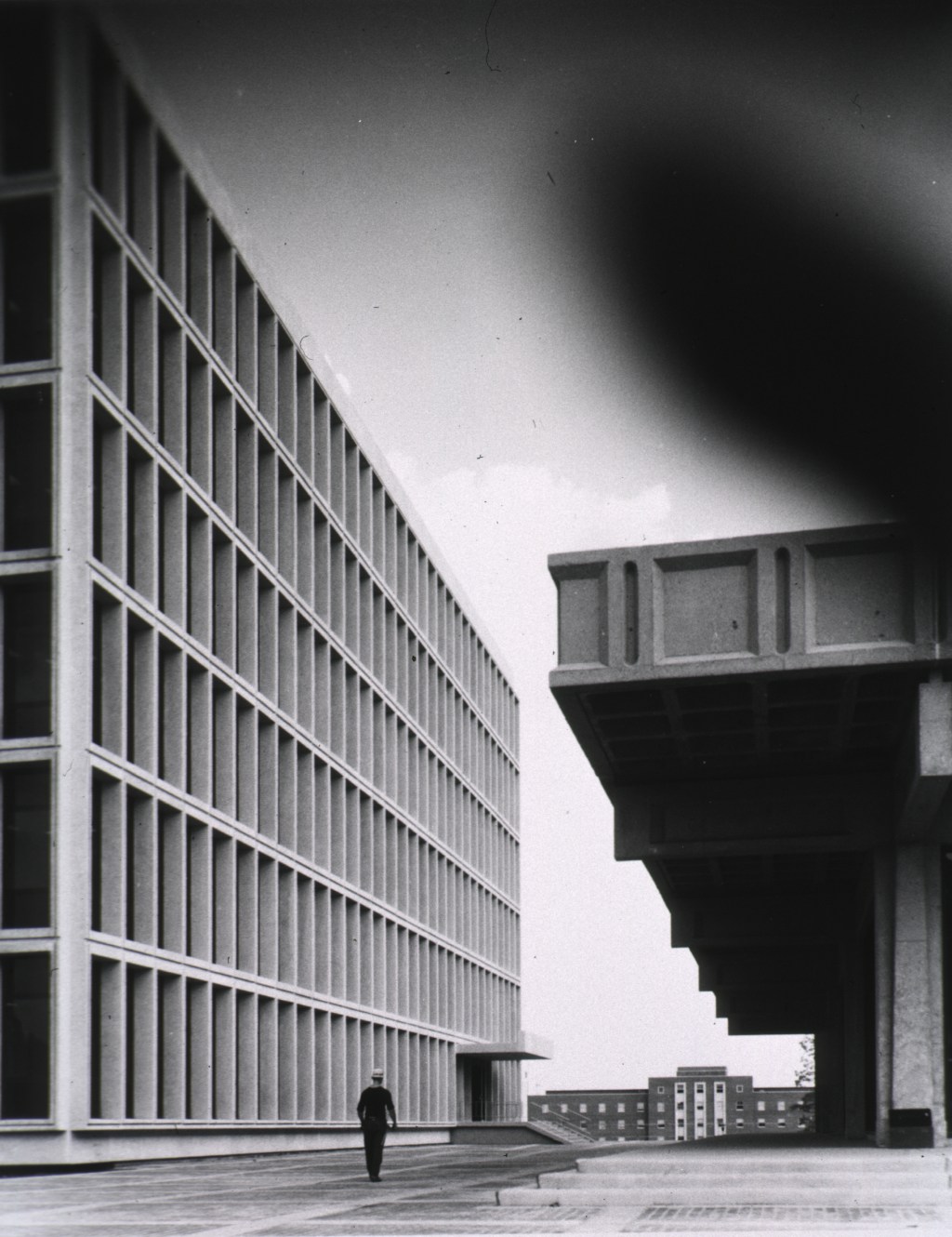
The physical sensation closest to this feeling of repetition, which sometimes lasts for several minutes and can be quite disconcerting, is that of a peculiar numbness brought on by a heavy loss of blood, often resulting in a temporary inability to think, to speak or to move one’s limbs, as though, without being aware of it, one had suffered a stroke.
W.G. Sebald, The Rings of Saturn, New Directions. 187
I left my apartment on the west side of 44th Street, in West Philadelphia, between Walnut and Locust, to walk to the 46th Street train station. I walked out of my door, down the steps onto 44th and went north half a block to Walnut. On Walnut I turned left (west) and walked straight. When I reached 46th Street, and just prior to crossing Walnut (again, going north), I stopped, as one stops when experiencing a moment of déjà vu, or its less common inverse, jamais vu, when the established familiarity of one’s world seems to vanish for a moment, leaving a sense of wonder or strangeness in its place. But it was not a moment of jamais vu, nor even a moment of déjà vu, for it is a condition of déjà vu that the person going through it cannot articulate the outlines or the objective point of reference to which the feeling is connected. Your friend turns to you and says, “I’m having the strongest déjà vu.” One never thinks to respond with “Déjà vu of what?”, because if such a question could be answered, the feeling would not have been one of déjà vu, but of involuntary memory, or at the very least a surprising recollection and its attendant impression of novelty. But I seemed not to be “having” a memory either; I did not stop in order to look into the distance and say to myself “Yes, this is how it was then…” nor to picture anything to myself in a pose suggestive of remembrance; and from the outset, the experience was an articulate one, it began as speech: I stopped in order to turn around and look at the building behind me, on the southeast corner of 46th and Walnut to say, out loud but to myself, “Isn’t there supposed to be a boxing gym right here?” I looked up for the sign that would answer my question and remove it from the sphere of the rhetorical but found nothing. There was no boxing gym, though I even seemed to picture the very one I expected to see when I turned to look for it (and simultaneously to speak out loud, as if to question my surroundings). I looked down, still paused on the sidewalk, and then raised my head, turning back again to cross Walnut, when, midway through crossing, the location of the boxing gym I was imagining occurred to me in a flash of diagrammatic clarity. It was a boxing gym located on the south side of Roßauer Lӓnde in Vienna. As I finished crossing Walnut, I had the feeling that I was also crossing Roßauer Lӓnde and that the stretch of 46th street after Walnut, crossing over Chestnut in West Philadelphia, was also the Siemens-Nixdorf-Steg, the pedestrian bridge going over the Donaukanal that was itself simultaneously Chestnut Street. The situation appeared like this:
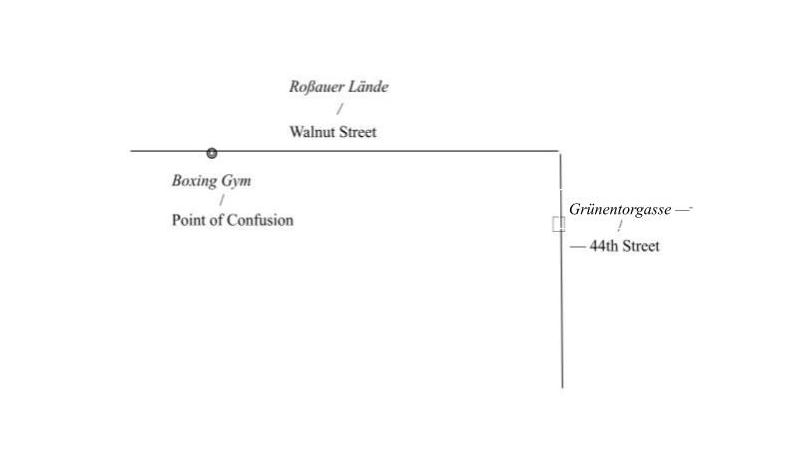
And this overlay, represented by two line segments and two points (though four actual points are meant by these two), had never occurred to me before—nor do I think that they “occurred” to me in an unconscious way, i.e., “from within me,” so that by moving through a space similar to another that I used to move through, in a similar way, a comparison was dredged up from the depths. It is rather that when I lived on Grünentorgasse and would walk up to Roßauer Lӓnde, I had moved, not just through the space of two meeting streets, but through something like the body of a dead yet revivable memory, the “having” of which there could be no question. By waking up every morning, having a coffee and going out the door, down the steps and onto the sidewalks of Grünentorgasse (even while writing this, I imagine myself doing so not there but on 44th Street, in Philadelphia), then briefly north, then west, I was moving through a world-mnemonic.
One is always walking through a graveyard of potential mnemonics and it is a quality of life or being that it can, at any time, perform a kind of necromancy on these spatial negatives of memory, reanimating the significance of an extension that is no longer present and which uses the field of extension that is present as the body that the latter space must possess. When I walked in an analogous path through my neighborhood in Philadelphia, I was illuminating through repetition a structure I had described with my footsteps in Vienna many times before.
Zane Perdue writes for various publications on a freelance basis as well as for his Substack, COM-POSIT (zaneperdue.substack.com). He is originally from Albuquerque, NM but currently lives in Door County, WI.
 BarBar
Leave a Reply