

Barb holds a swatch of Chuck’s hair between her forefinger and middle finger and cuts straight across with the scissors. She is trying to recall the last time she touched his hair, when the steel tips of the scissors snip the top of her knuckle on her left-hand middle finger. It happens so fast she doesn’t register the pain. Blood wells on the gnarled knob, dark and vivid. She is enchanted.
“Barb?”
The blood gushes. She sets the scissors down and grabs a tissue. Chuck’s eyes flick to hers in the mirror—a sharp look, like a sheet of paper sliding under her fingernail leaving a papercut she’ll never see, but whose sting she’ll feel later. Mind wandering, Chuck would say, is the source of all the nicks, bumps, and scrapes she gives herself. Gives herself! As if they were presents.
The white tissue fills with blood. She dabs the gash, pulling on a flap of skin that sticks up, still attached, triangular. More blood pools. She marvels at the thickness, the roundness of it as it sits on the top of her knuckle like a perfect drop of paint.
“God dammit, Barb.”
Chuck rises from his seat and strides to the bathroom, straight and narrow, straight as an arrow. Cabinet doors snap open and shut and now he is back and peeling the soaked tissue off her knuckle. His fingers are as gnarled as hers. With deft gentleness, he presses the band-aid to her knuckle and shapes the elastic around its contours. Precision with kindness. Sometimes he surprises her.
“There,” he says and sits back down in the chair, presumably so she can finish the haircut. She picks up the scissors, but the knuckle under the tight band-aid throbs. She sets the scissors down and runs to the bathroom.
“Barb?”
Her hand can’t breathe. She knows that’s crazy but that’s what it feels like. She strips the band-aid off in one motion. The edges of the triangular flap of skin are as raw as chapped lips while the gash itself is pink like a piece of uncooked meat or a fleshy tongue—bumpy and pulsing and here comes the blood welling up again, dark, thick as ink, and bubbling. The bubbles pop. The gash burbles. It stirs, like a living thing.
Then it screams.
Barb shrieks—a high-pitched squeal like a surprised dog—and in the split second of her shriek she thinks, It’s me. I’m screaming. Not the gash. But her throat dries up and sound still fills the bathroom. A long, loud, full-lunged scream.
The door bangs open and Chuck grabs her shoulders and squeezes her, as though she were a wooden doll he’d just glued back together. “What is it? Where are you hurt?”
Listen, she wants to say but she cannot make the word with her mouth. The gash wails. A high, keening cry like a seagull over the ocean.
Chuck stands behind her. “Barb. Barb. We can’t have this.” He turns her around, carefully, keeping her hand between them. His eyes bore into the wailing gash, like that time he spotted the copperhead in the woods, and he kept her away from it. Back, back, he stalked it backwards and stared that snake down until it whip-slithered across the path and away into the brush. He stares just like that now at the gash in her knuckle. He is all eye.
I hear, she thinks. I am ear.
The wail turns to a ululating trill like a dozen tongues might make. A dozen goatherds, maybe? What does she know about goatherds. She was a schoolteacher. She knew the way kids called and hooted on the playground and that’s what the gash sounds like now. A frenzied calling. Come on! Come on!
Chuck steers her to the linen closet. “Hold still,” he says. A flash of white. A long strip. He wraps and wraps her hand. Muzzling the gash. Gagging it. Now the wail is dim and muffled. The knuckle aches.
“There,” Chuck says. “Hold it.”
She holds the gauze in place while Chuck tapes it all together, like a makeshift cast. A shroud, she thinks. But that isn’t right. Her hand—the knuckle—it isn’t a dead thing. It’s alive and crying. And singing. Softly now, because of the bandage, but steady. Like the rhythm of a heartbeat—or like the pulsing of a fetus in utero—not that she would know anything about that. She looks at Chuck, his mouth a straight line. Straight and narrow. Straight as an arrow.
The gash is a voice at the bottom of a well. Barb cradles her hand and pushes past Chuck out of the bathroom.
Chuck
He would’ve gone to the barbershop for the haircut except Frank retired and moved to Florida. Rent too high on the building, Frank said. Feet too old for standing all day cutting hair and folk don’t want the old-time barbering anymore do they? The only other place in town is a hair salon, one of those corporate franchises where you need an appointment and they play music like it’s a god damn night club. Chuck walked in there once and turned right back around. Place reeked of sweet, fatty shampoo. Barber shops are supposed to smell of men and soap and that’s what Chuck wants when he sits in the chair. Frank’s big hands, the crisp flash of scissors, the smell of soap and sweat, and the licorice on Frank’s breath that he chews to mask the cigarette he smokes out back on breaks. Chuck could sit in the chair and close his eyes, listen to the men’s slow talk and think. Really think. It was almost as good as mowing.
The way he figures it, it’s his own damn fault Barb sliced her knuckle open. She’d never cut hair before, but was game to try. He likes that about Barb. How open she is. If they lived in another time or had a lot of money, he might say to her, Barb, let’s go live out west. Let’s go live on a boat. She’d mull it a moment, smile, and say, okay, sure. Of course, he would never propose such things.
Now it’s clear as day that Barb is far too open. Everything has come to a bleeding halt since the wound started singing. The god damn thing is worse than a squalling baby. A baby’d be something they would’ve made together. It would’ve been half his. Barb’s wound belongs to her. He can’t understand it. Neither can she, he is sure, although that doesn’t seem to bother her. She sits on the couch, listening to the wound wail through the bandages, with a rapt look on her face—like she’s hearing a message from angels or aliens. She’s given herself to the wound completely. He may as well not exist. He runs his hand over his half-cut hair.
He leaves the bathroom and goes in search of the clippers.
Barb
The gash sings under the bandage. Sometimes it’s a meandering, melancholy murmur. Other times it’s cheery and the song quickens her heart. It goes on for hours. She can’t think about getting anything done. They eat bowls of cold cereal for dinner. She holds her hand like a baby. Chuck says, “How much longer are you going to carry on like this?”
She doesn’t look at him. Her eyes are closed. “Until it’s done.”
She knows he doesn’t understand. Doesn’t expect it of him. She has to see this miracle through. She has to hear all of it. This singing gash is momentous. Her whole life, perhaps, has led to it.
Chuck
He plugs in the clippers and buzzes his hair off in quick, efficient strips. Gray hairs of uniform length fall onto the floor and lie like iron filings, scattered around his chair in a perfect circle as though he were a magnet. They all point north.
The buzz is glorious and soothing. For a few minutes it completely masks Barb’s wound, talking over it with a steady droning noise—like the sound of a lawn mower—grinding, loud, predictable. You know what it is saying. Not like the melodic weirdness of the wound—the way it rises and falls in a great big crash one moment and then in the next croons softly like a lullaby.
He snaps the clippers off. He’s run out of hair.
The wound trills. Barb looks up from her knuckle. “What did you do that for? I was going to finish your haircut.”
He runs a gnarled hand over his smooth pate, no bumps, no ridges, no stubble. “Now it’s done,” he says. He oils the clippers and packs them away in their carton.
“You’re going to be cold,” Barb says. She lies on the couch, stroking her bandaged knuckle with her gaze. Anything she says to him now is automatic. Word spit. The way she talks after two glasses of wine.
Barb’s wound sings a complicated melody. He places both hands on his shaved head and presses his fingertips together.
“You’ll need a hat,” she murmurs. He watches in dismay as she unwinds the bandage on her hand with the careful, slow attention of a lover.
Barb
The bandage resists a little when she peels off the last segment, her blood acting as glue to the white cotton. There’s the brief prick of pain and then nothing separates her from the glorious singing of the gash. It’s a rush of air in a stuffy room, the shock of skin on skin, the burn of whisky on the back of the throat and the way it wafts up through the nose, flaring the nostrils with smoke and scent.
The gash makes her feel alive.
No more languishing on the couch like an invalid. She strides through the house, she dances and sways to the gash’s song like a teenager grooving to tunes in her headphones. Her own private world of sound. Chuck is a distant background figure—like an uncomprehending parent. Has she ever done this? Danced to music with such abandon? Riding the tide of emotions they elicited—hers and not hers? There’d been a record player once, she is sure, in her childhood home. She danced with boys—sweaty, drunken jittering and jumping—but it was always someone else’s music.
The gash sings throaty and deep and she is inside it. It plays feelings she’s always known, but never inhabited—the death of her parents. The creaky ache in her joints. The dull, receding passion she used to have for Chuck. The baby she never had.
The baby. Now the gash on her knuckle is a bleating mouth, a squalling infant desperate for milk, for love, for warmth, for a million different things and she has no idea what to do. She rushes to the bedroom, as though there were a baby there—a soft, wriggling bundle to pick up and soothe. But there is nothing. The bedroom is empty—full of furniture they’d inherited from both sets of parents. Their parents are dead and they are old and there are no children. No one to come after them, to pick up the trailing train of their lives and march on holding the delicate fabric up out of the mud and the dust. No little ring bearers and flower girls. They’d made nothing, she and Chuck.
She curls up on the bed and cradles her hand, cooing and crying at it. After a while she can no longer distinguish what comes from her mouth and what comes from the gash, but it seems to her like they are fashioning something together—a thick, knotted cord—strong, pulsing—a coil of sound—and that this secret work in the dark is the most important thing she could ever do.
Chuck
He wears a hat to bed that night—a red and black striped hat Barb knit him long ago. It keeps his head warm, but fails to block the sound of the loquacious wound. Chattier than a church lady, he thinks. He lies awake in bed next to Barb, on his back, while the wound’s unceasing singing curls around the sheets and suffocates his sleep. She will never shut the god damn thing up. Her back is to him, and she holds her hand close to her breast, like she’s guarding it from him, some treasure she’ll never show him, much less share.
Enough. He needs to sleep. And what about her? Will she go all night without any shut-eye? It shocks him when he hears her breathing, regular and low—a rhythmic bass to the high-pitched wound. Despite the racket, she’s fallen asleep.
He slips out of bed, squeezes a thick line of petroleum jelly onto his finger, and approaches the wound slowly and quietly, like a hunter raising his rifle. No muscle moves except the finger with the jelly. A little dab might shut it up.
Barb stirs in her sleep. A smile flits across her features, like something she is trying out, the muscles of her cheeks tremulous. It is such an unguarded look—how she might have looked as a child—the unselfconsciousness of pure bliss. A total easing of pain, judgment, and worry. It flickers on Barb’s face for two or three seconds and then it’s gone, but it’s enough to stop him, his finger all glommed up and gluey with petroleum jelly. The wound sings on, a high, whispery tune that winds around Barb like a ribbon.
He stands up straight and backs away, smearing the petroleum jelly in his own ears. He packs it in good and tight and then goes back to bed. Lying next to Barb on his back, he revels in the fullness in his ears, the two brimming cups of silence balanced in perfect proportion on either side of his head.
Barb
She wakes to a profound hush, like the morning after a snowfall—a white, thick silence draped over the world. The gash is still pink like raw hamburger meat, slightly puffy, and it aches like a far distant drum beat. A beat that she can’t hear but that vibrates deep in the bone. She tries to listen. Wants to listen, but can’t, because it’s the wrong sense. The silence stretches out long and elastic while the drum beat of the ache finally settles into the pounding of her blood. She can’t hear that, either, but she feels it, and the veins in her hands pop out like ridges. A thick one curves over the top of the wounded knuckle. She’s never noticed it before. How it circles the top of the knuckle like a ring. Like a wedding band.
Chuck
Hands shake him.
“Wake up.” Barb’s face is blurry. Her voice is muffled, like she’s underwater. The jelly in his ears. He massages his outer ear, works his jaw until he feels the hinge of the TMJ pop, waggles a pinky in his ear to open up some space.
“Chuck?” Barb is a question mark. Head cocked. One hand on his chest. The other hand—the one with the wound—hangs by her side.
He sits up. “What happened?”
“It stopped. Sometime in the night.” She pats his chest—distractedly, he thinks—as she looks around the room, squinting, as though she’d never been there before.
He grabs her by the wrist and pulls her hand toward him to inspect the wound. The knuckle is red and raw and a scab sits on top of it. A scab, already? The little triangular flap that Barb cut open is cementing itself back to her skin. It looks like a smile. A tiny red smile on the wrinkly knoll of her knuckle.
He drops Barb’s hand. Launches himself out of bed. No morning stiffness for him. Barb is putting on her robe. She rummages in her top dresser drawer. He knows what she’s up to. “You gonna cut yourself someplace else?”
“No.” She slips the scissors into the pocket of her robe.
Barb
The bathroom tile is cool on her feet. She sits on the toilet seat and thinks about all the times the red tinge of blood in the bowl mocked her. Told her she wasn’t pregnant. How it always felt like her insides were crying themselves out, her uterus twisting and churning, the cramps performing her emotional pain. No baby. Not this month. Not ever. The menopause came years ago.
The gash on her knuckle knew all that. It knew and it understood. Maybe she can slice something else open. Something more private. She has a bunion on her left foot. That’s bony like a knuckle. She can slice the bunion and see what it has to sing, dig into the other deep places of herself. The anticipation of the cut tingles. The heavy steel of the scissors presses against her leg through the pocket. She lowers herself to the floor, drawing the scissors out of her robe.
Chuck
The wound’s smile burns him up. He pulls on his pants and threads the belt through the loops. His pocketknife is already in the front left pocket, where a man keeps his knife. His last year at work before retirement there was a company picnic and he was shocked to be the only man there with a pocketknife. Someone had brought a case of beer and the young idiots couldn’t get the thick cardboard open. No one had a knife. Chuck made quick work of it. Hey, man, thanks, you sure you don’t want one? They all wanted to press a brown bottle into his hands. Systems engineers with big brains and bigger mouths and ears too big like a puppy’s and not one of them had a pocketknife. Barb had chuckled at that story. Straight and narrow. Straight as an arrow, she’d said. They didn’t know you were a boy scout at heart.
Not at heart. In deed. That was the whole god damn point of “Be prepared.” You never know what’s going to happen. Being prepared is duty.
Silence from the bathroom where Barb has a pair of scissors, he’s sure.
He sidles up to the door and listens. He learned long ago to not interfere in other people’s business, but he can’t let Barb hurt herself.
Plus, he doesn’t like the smile on that scab.
He is knocking on the door. He is doing his duty, god damn it.
Barb
Three taps sound on the door in perfect, metronomic rhythm.
“What is it?”
“You all right in there?”
“I’m fine.”
“Say again?”
“I’m FINE.”
Chuck
The word is a smack, the thwack of his father’s open palm on his mother’s cheek. His body flushes with the heat and the shame of being seven years old and watching your father smack the shit out of your mother and wondering why she just couldn’t be quiet for once. Why couldn’t she just bury it all down deep and say nothing?
Barb
She locks the bathroom door. She can’t think about Chuck now.
A fuzzy hum roars through her ears, like the white drone of an air conditioner. She shivers. That’s good. That means it will work. She lays the scissors against her boney bunion. It’s only skin, it’s only paper, she thinks. Just a snip across the top. The scissors are cold and hard like the floor. One cut and the numbness will go away. The pain will flood in and then the joy, the ecstasy of the release. The scab on her knuckle throbs.
The steel tips of the scissors open like a mouth.
Chuck
He walks down the hall, through the kitchen, to the back door. Outside. He needs air. He runs his hand across his bald head, longing for the hum of the clippers or the buzz of the lawn mower. He keeps a beautiful lawn, neat and trim, not a weed on it. Bluegrass. He mows with a gasoline-powered push mower, back and forth in careful rows so the lawn looks like brushed velvet, blue-green, green-blue, alternating in stripes. But he mowed the lawn two days ago. Too soon to mow again.
He is back inside the house. The bathroom door is still closed.
Back outside. Maybe he could see if the neighbors want him to mow their lawn. The neighbor’s lawn is full of children’s toys. Overturned scooters and bicycles, buckets and balls. Like a god-damn thrift-store turned upside down. He’d have to pick up all the toys and find them a place before he mowed their lawn. The prospect of bringing order to their chaos, to making a system for the toys steadies him.
But the neighbors aren’t home and he is not the kind of man who does something to another man’s property without permission. He does move a tricycle off the walkway. How many kids do these people have? Three, four? He and Barb tried to have kids. Something didn’t work right and a baby never came. Barb wanted to adopt. A baby is a baby, Barb said. But he couldn’t wrap his head around it. What if he couldn’t love another man’s child? Who were they to decide they could raise a baby when they couldn’t make their own—wasn’t that the height of hubris? Better to remain as they were. He never said no to Barb, and she never pushed him on it, so they did nothing and now they’ll die childless.
He walks the plush pile of his bluegrass lawn, up and down, following the rows the mower laid out. Fine, she said. She is fine. The lawn is fine and their whole lives are fine. Not a god damn thing to complain about.
He steps on the rubbery knob of a weed. The mower has clipped it to the length of the grass. A bitterroot sapling. If he doesn’t pull it root and all, it’ll latch on deep and he’ll never be rid of it. He strides to the shed for a spade.
Barb
As the blades of the scissors press into her skin, she flinches. Blood rushes in her ears. She knows what this is. The animal instinct for self-preservation. The oldest part of the brain—the monkey mind—is ringing an internal alarm. The knuckle she sliced by accident. For all she knows that’s what made the gash sing. The shock of it. The shock of hurting herself, of opening herself up.
The scab on her knuckle aches. Chuck would just do it. Straight and narrow. Straight as an arrow. He would hack off his own arm if he had to. She grips the scissors. It’ll be worth it, she promises the monkey mind. To hear her body sing again.
Then she hears the deep, thick plunge of a spade sinking into the ground outside. She pauses, listening with her whole body, scissors still open.
She hears it again. The thwack of a spade. The swish of falling dirt. There is a metronomic rhythm to it.
Chuck
He thrusts the spade in the deep blue-green of his grass, then lifts it skyward. A wedge of red clay spews out. The underbelly of the grass. Thick, sludgy dirt spills onto the pile next to him. The bitterroot sapling is long exhumed, its pale roots already shriveling in the sun.
He digs again. He piles the dirt high. Every thrust of the spade is strong and regular. Straight and narrow. Straight as an arrow. The thunk and thwack of metal in dirt vibrates up his arms and spreads into his chest. Digging and sweating and chucking up dirt and if he listens hard, he thinks he can hear them. His thoughts. All of them.
Barb
She stands on the edge of the tub and peers through the bathroom window, bare feet sticking to the porcelain, terry cloth robe loose around her body. The scissors lie upon the floor and they might as well be a foreign object in a foreign country, they are so far away. Everything is far away except for Chuck who is digging a hole in his beautiful lawn. The dirt rises behind him, a pyramidal knoll with bits of blue-green grass sticking out, like an island suddenly rising out of the sea.
This is unthinkable—as unthinkable as the singing gash. What had it sounded like to him, anyway? She rubs the meat of her thumb over the scab, feeling the crust, the tiny grooves in the hardened skin, but only a sliver of her mind touches the gash now. The rest of her watches Chuck dig a hole and fill it with his silent grief. She thinks briefly about sliding the window open but can’t bear to break the moment—the holes, the pyramid of dirt, Chuck digging in the sun, the sweat shining on his bald, white head, the hot circle of her breath frosting the glass. It is quite possibly the most significant moment of their long marriage. And he doesn’t even know they are sharing it. She laughs out loud about that but then Chuck overturns another shovelful of dirt. Sweat drips down his face and into his eyes and he does not wipe them. She presses her face to the glass of the bathroom window.
Chuck
The motion is everything. It drives and delights him. He digs with the ache in his arms, the tightness in his back, the burning in his legs, and the bright sunlight blinding him. On the upswing, when he releases earth into air, he wonders if maybe this is how Barb felt when the gash sang. That she was a part of something. But not in charge of it. And if so, if this is what she felt, then that was fine.
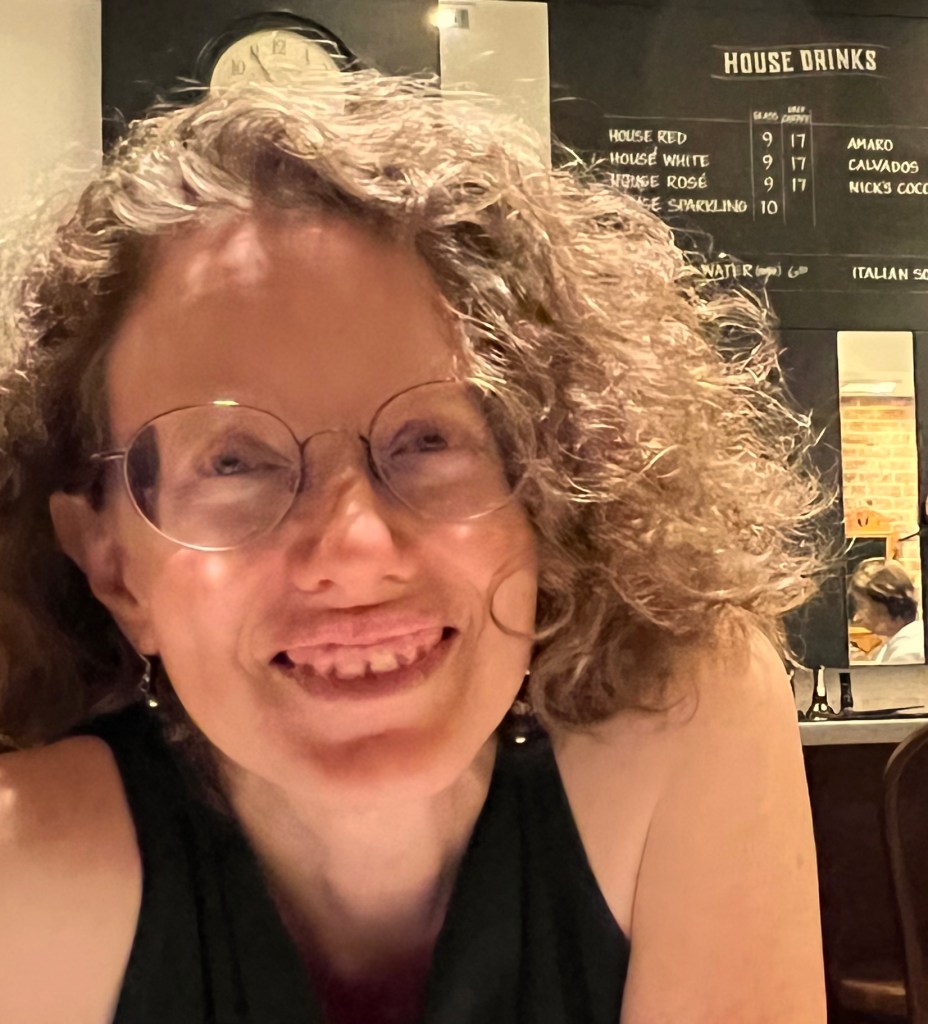
Carolyn Fay is a writer and teacher currently based in Charlottesville, VA. Her work appears in literary magazines such as Orca and Paper Dragon, as well as numerous children’s magazines. She holds a Ph.D. in French literature and has a garden that looks like a cemetery.
 BarBar
Leave a Reply