
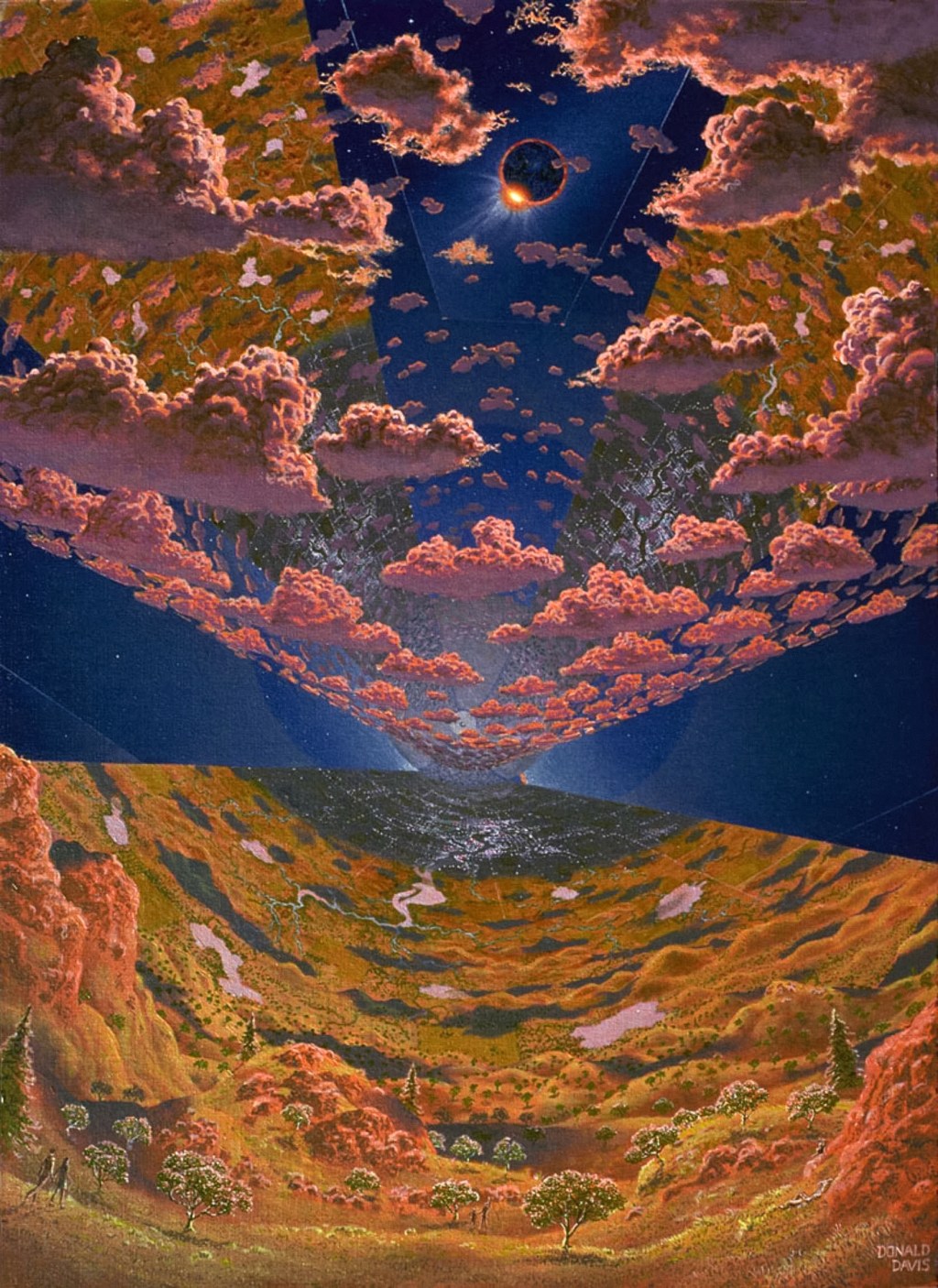
“What happens after we die?” is a question that has intrigued humanity for ages and is perhaps the greatest enigma of all time. Of the estimated 118 billion humans that have lived and died, zero returned with proof of an afterlife. Those claiming post-death experiences have yet to provide empirical evidence that life endures long after death. However, from a scientific perspective, we do know the following:
- Neither mass nor energy can be created or destroyed. Instead, they merely change form. We are no exception to this rule.
- We are all made of trillions of atoms whose lineage can be traced back 13.8 billion years to the universe’s inception.
- We are the result of supernovae changing form.
Despite our increased understanding of universal physics, we still revert to our mortal perception of time and primordial fear of death. It’s hard for us to accept that after stewing for eons in a planetary crockpot, we only get a few decades to warm on a tectonic plate. And once consumed by the maw of time, the infinitesimal odds of our atomic building blocks ever restructuring into anything resembling us remains far beyond the burden of proof, let alone our realm of imagination.
99.9% of all earth’s species have gone extinct. Yet the survival of our species and all surviving species provides evidence of an afterlife. Individuals die, but their DNA, which connects us to our ancestors and descendants, lives on. This continuity of life is a source of hope and connection. Though precedent suggests that anything biologically complex evolving from one person’s death (no matter how notable the person) will not appear in our lifetimes. Our ancestor’s conspicuous silence remains muted by the sheer amount of time, complexity, and luck for their octillions of atoms to coalesce into anything recognizable to us. Yet many of us have been taught of a more direct ascension to an afterlife or a “heaven.” Unfortunately, these teachings are based more on superstition than evidence. They also prey on our mortal beliefs of being divinely created, and despite having sinned, we will be saved. This dogma presents death as a valediction from a lifetime of suffering, as well as eternal damnation for those who inflict suffering. Our faith in a “heaven” remains far more comforting than calculating the odds of our 6,000,000,000,000,000,000,000,000,000 atoms reuniting for a reunion of us.
Our DNA provides the “software” to the trillions of cells that constitute our “hardware.” These countless interactions create the infinite complexity we perceive as life. But it’s the simple ionic sodium-potassium pumps within each of our cells that generate life. Like the rest of us, these pumps are ultimately powered by the sun, but when time, trauma, or disease seize our pumps, cells shut down like batteries that can no longer be recharged. And when our cells shut down in mass, we die. From there, our atoms scatter, some combining with organic matter, while the rest settle into the earth’s terra or sail off into the atmosphere.
Someday, we may fully measure the transfer of mass and energy, including human mass and energy. Yet, the results appear to be growing increasingly complex based on evidence of universal entropy, accretion, and creation.
For example:
From the crucible of the Big Bang emerged primordial hydrogen…
Fueled by hydrogen fusion, stars birthed heavier elements like helium, carbon, and oxygen…
These elements, powered by our sun, allowed microbes to evolve into bacteria, algae, plants, animals, and ultimately, earth’s increasingly complex biosphere, which includes us…
While we focus on the day-to-day, the universe continues its long-term plan. And despite owing our very existence to its impressive 13.8-billion-year body of work, many of us treat the life given to us like Gollum, futilely attempting to protect his “precious.” For the first time in human history, we have empirical evidence surrounding our creation. We now recognize that we will die, but our collective DNA will continue (if we do not go extinct). This truth provides a silver lining: Our expanding evolution has created increasingly complex organisms and biospheres. We are evolving in ways we may not recognize now but will gain more understanding in the future. And given what human evolution has created, especially in the last few millennia, the next several could prove quite interesting. Yet, regardless of what evolves from us or how long it may take, we will go from being “created” to being a “creator.” After all, it’s happened before.
Children of the sun.

Jeff Hennelly has provided medical care and medical devices from Philadelphia to Prague. He has published a novel, The Power, and his stories and articles have appeared in Havick, Change Seven, Sterling Clack Clack, Red Weather, and other journals. He has three children and a cockapoo in training for frisbee competitions.
 BarBar
Leave a Reply