

My mom was busy cooking majedra with yogurt, her gold bangles echoing her every move. My sister, Debi, was in our room writing in her diary, and my brother, Dorian, and our dad were on their way home from work in Manhattan. Our apartment building was on 83rd Avenue, sandwiched between Kew Gardens Road and Queens Boulevard in Kew Gardens, Queens. I was five years old.
My grandfather, my father’s father, came to our apartment every Thursday for dinner. He was nearly blind. My mother called him Monsieur Lisbona, but to me he was Gido.
Gido spoke in a mixture of French and Arabic. He had been born into a wildly wealthy family in Damascus in the previous century and lived a solitary life in Brooklyn.
Whenever he saw me, he would put his hand in the pocket of his gray slacks and search for candy, jingling coins in the process. The candy was hard, the kind you sucked till you got to a syrupy center. It came in a wrapper that was twisted on both ends. My favorites were the red ones.
When the doorbell rang on one particular Thursday night, I ran to get it. I opened the door and saw my Gido, and then I did something that I didn’t normally do. I held my hand out to receive the candy, as if this would gain him entrance to my home. He reached into his pocket and came up with a handful of coins and some lint. No candy. His face fell, and I felt bad.
The next thing I knew, he grabbed my arm and led me out of the apartment. I had never been under his care before, especially outside of my home. We were walking down the steep hill towards Queens Boulevard. I looked both ways for cars, but I had no idea when to cross. I wondered how he would manage, and then I reminded myself that he came to us every week on his own, by subway. “Allez,” he said against the wind. “On y va chercher de bonbon.” I held his hand tightly, maybe the first time I had ever done so, and we arrived safely at the newspaper store that sold candy.
As Gido stood in line, I was looking at the twirling rack of toys. He gestured to me to choose something and bring it to him. A bright pink faux leather wallet caught my eye, and I put it in his outstretched hand. He paid for it. Again, he had never done this before, bought me something so extravagant.
By the time we got home, my family had gathered, and we sat down to eat together. I didn’t show the wallet to anyone. After dinner, Gido pulled a chair up to the TV, his eyes inches from the screen, to watch wrestling with Dorian. They cheered and shouted for Bruno Sammartino. Gido was so unlike my father in this way.
A short while later, maybe the following week, Gido didn’t show up on Thursday for dinner. My dad got in our Volkswagen Beetle and drove to Brooklyn. My father told my mother that he found Gido on the floor of his apartment, that a mirror had fallen off the wall and hit him on the head. My father took him to the hospital on York Avenue in Manhattan. On Friday while my parents visited Gido’s room, I waited alone for a short while in the lobby on a bench near reception. I knew Gido was sick because of the mirror and that my parents were very serious, but that was all. I sat there quietly, and when my mom came to join me , I was relieved.
When we got into the car to go home that night, my dad put a container of Philadelphia Cream Cheese on the seat beside me. I opened it as he pulled out of the parking spot. I thought I would find cream cheese inside, but instead there was a set of teeth. They must have been Gido’s dentures. I screamed as if it were a crawling spider that I had unleashed. My father snapped at me, articulating with each syllable how important it was not to scream when someone was driving. As he spoke, he blew the smoke from his cigarette into the windshield for emphasis.
On Saturday, I was in the kitchen with my mom and Debi. My mom was talking into the yellow phone attached to the wall. I could tell Debi understood what was being said and even what was unsaid. She crouched down on the floor beside me. “Gido died,” she said, her voice kind and her eyes close to mine. Debi made a sad face for me, and I knew that I should have a sad face as well.
The day of the funeral, my family left me home alone: Funerals were not appropriate for children, my mom explained. She told me to get on her bed. “Don’t move from here,” she said. She put on a double feature of Abbot and Costello. She looked at her watch. “When both movies are over, we will be home.”
The door clicked shut, and I felt marooned on that blue bedspread. I didn’t understand why I had to be alone for so long. I closed my eyes tight when I remembered how I had thrown the new wallet in the corner of my closet. My father, who always had a smile for me, seemed unreachable. I watched TV, and sometimes I laughed, and for those few moments, I forgot I was alone. Mostly, I twirled my blankie in the air as I lay on my back and anxiously waited for my family’s return.
The following Thursday we had majedra and yogurt without Gido. My father chewed his food, and I watched him for signs of sadness. Except for the sounds of the utensils, we ate in silence. I understood that I would not see Gido again. No more red candy, no more wrestling on TV, no more Monsieur Lisbona. I never played with the wallet. I didn’t even want it anymore.
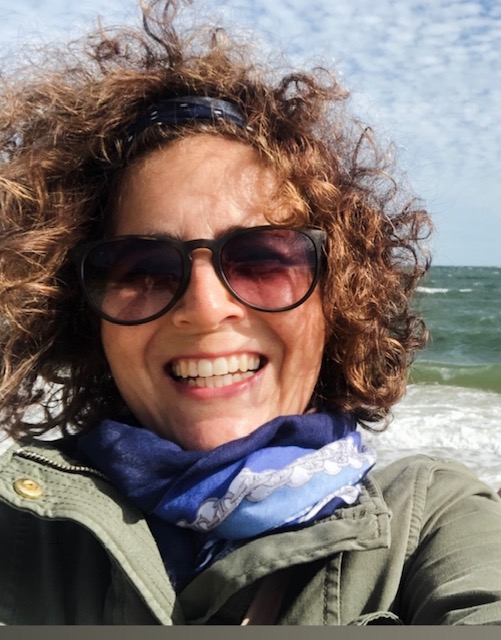
Leslie Lisbona has been published in various literary journals, most recently in Wrong Turn Lit, The Bluebird Word, and Dorothy Parker’s Ashes. She was featured in the New York Times Style Section 3/24. She is the child of immigrants from Beirut, Lebanon, and grew up in Queens, NY.
 BarBar
Leave a Reply