

An individual expressed apprehension about flying to the United States on September 11th. Within his circle of acquaintances, one held a job at the Super Runner Shop in the World Trade Center’s basement. Prior to the collapse of the twin towers, the employee emerged uninjured.
At some point, the New York Historical Society curated an exhibit on the tragedy. Despite the ample testimonies, the presentation fell short of providing concrete artifacts to satisfy the public’s curiosity. Apart from a dented payphone cabin and a riddled air traffic beacon, both positioned on the aerial terrace of the World Trade Center tower, the huge collapse destroyed everything else.
The public opinion desired additional things. The vast majority wanted revenge without searching for the deep cause.
Few bothered to read the Koran. For a short period, crates filled with copies in English occupied the first floor of the Bordas bookstore, a place the individual used to frequent.
The contrarian booked his flight the day before the fateful anniversary. The frugal traveler also steered clear of a pricey direct cruise bound for Washington. He settled for a connection to Frankfurt am Main, Germany, using the services of the Lufthansa airline company. Once again, he took advantage of the chance to book the cheapest flight available from Charles de Gaulle Airport, scheduled to depart at 6 o’clock.
In order to prevent any disruptions on his way to the airport, the traveler reserved for a taxi service to collect him from his residence in Paris at 4 o’clock.
“Our chauffeur will call you when he reaches your street,” confirmed a secretary from the taxi company.
The client leaped out of bed when the phone rang at night.
“Excuse me, but I’m waiting for you,” drawled a voice in a thick foreign accent.
“I’m so sorry!” answered the panic-stricken client.
“Never mind,” replied the taxi driver, his voice drowned out by Arabian traditional music. The oud, a predecessor to the lute, and a flute crafted from a hollow cane, enhanced the quality of the funeral experience for the traveler’s journey.
The client contemplated rescheduling his trip on that unfortunate anniversary. Once he regained his awareness, he questioned, “What is the day today?”
“It is Tuesday,” said the cabby.
“But I reserved for Wednesday,” responded the upset client.
The taxi driver seemed taken aback by what had transpired. In order to address the client’s frustration, he decreased the volume of the music. “I did not know it,” he said.
“I must apologize, as there seems to have been a misinterpretation,” acknowledged a receptionist from the taxi company during regular working hours.
At the agreed time, a cabby awaited the client in a minivan. With his thin frames and round eyeglasses, he did not fit the stereotype of a taxi driver; he looked more like holding down a white collar job.
The passenger inquired about other clients who might delay the travel. “No Sir, you are our only customer for the airport today,” he answered.
During the act of putting the individual’s backpack in the van’s rear, the cabbie commented that Tuesday and Wednesday had experienced less activity compared to the other days of the week.
The freshman understood it not through personal experience. In fact, his employer extended an invitation for him to work during these two slow days to acquire skills in the craft.
Still, the demanding job did not align with the nerd’s abilities. Fed up with the routine of his existence, he yearned for a nocturnal job in the vibrant urban center. Also, he believed his job exposed him to a range of strange experiences, which would motivate him to write a book.
A copy of Journey to the End of the Night by Celine lay on the front seat near the driver. His familiarity with book titles outweighed his knowledge of street names, contributing to the problem.
The cabby’s cultural knowledge provided little help when the minivan reached the peripheral, a twenty-mile loop highway encircling Paris.
Nighttime maintenance led to closure, showed by a warning sign. A massive crane hovered above the dark waters, lighting up a bridge that stretched across the Seine. A group of twelve workers, all wearing hard hats, performed tasks on the bridge, surrounded by the glow of artificial light.
Thrice, the taxi driver took the wrong route instead of following the correct one that would lead to the Maréchaux boulevards, an inner loop of the peripheral.
“We are stuck in the outskirts of Vincennes zoo,” deplored the client. Afraid of missing his flight, he supported the freshman in navigating the confusing merging roads.
Upon reaching the boulevard Poniatowski, the tension subsided. On a side note, the street’s name paid homage to a Polish prince who sided with Napoleon I.
To recover the time lost in the suburb, the taxi driver pushed on the accelerator pedal. Therefore, the individual grew concerned about the reckless speed and clung onto the ceiling grab handle. Only garbage trucks contributed to a slowdown towards Charles de Gaulle Airport.
The vehicle’s arrival on the highway leading to the airport brought a sense of relief to the customer.
“The minivan won’t get stuck behind a garbage truck anymore,” he reassured himself.
When the taxi driver dropped off the client, the registration desk of Lufthansa at terminal one remained closed.
“There was no necessity for all that haste and concern,” lamented the restless traveler. He yearned for a cup of coffee, but the shops inside the concourse remained closed in the wee hours of the morning.
In that mundane atmosphere, a pragmatic young man dozed off on a sleeping pad. A kind janitor woke him and requested him to gather his belongings before the security guards came.
The undisturbed young man complied right away. He squeezed the air off the mattress with his knees before folding it. The clever youth, avoiding hotel expenses, did not mind sleeping in public. An undying bonhomie radiated from him.
At 5:30 a.m., the clerks working for Lufthansa arrived to find five early birds waiting in line behind a security cord. In their midst stood the young man donning a chullo, a knitted wool cap with earflaps, alongside the individual.
“It seems like Frankfurt isn’t your final destination,” observed the individual.
The young man responded, “Your guess is accurate, Sir.”
“Instead of using Sir, please address me as Waffle Print,” requested the middle-aged traveler.
“That’s quite an odd nickname,” remarked the callant.
The individual clarified that long-distance hikers in the United States gave him this moniker because of the waffle-like pattern his boots made on the trail. He declared himself as an old-school individual who opted for boots instead of sneakers when traversing trails.
To make a long story short, the recognition came in the Mount Adams Wilderness, Washington State. A heavy snowfall caused a noticeable impact on the hares sporting sneakers, while the turtle, equipped with heavy boots, remained unaffected.
The hares’ adventures ended as they attempted to track waffle prints on the snowy terrain. While the fast-paced hikers treated their frostbite in town, they felt frustrated by their defeat against a steady middle-aged man.
“Are you up for the challenge of scaling mountains in the Andes?” Waffle Print inquired about.
“Renting a bicycle and exploring the Andes passes is all I want,” the callant responded.
“I am confident that you will achieve great success,” replied Waffle Print.
After completing the registration process for their boarding pass, the group of five early birds navigated through the terminal. As they reached the security fence, the controllers underwent inspection by private guards before starting their duties.
With the perplexed passengers watching, a female controller underwent a comprehensive search. It involved inspecting her entire body, including the palpation of her crotch.
Despite the embarrassing frisk, the stunning woman harbored no resentment. She faced that daily humiliation to ensure the passenger’s security.
“It’s always tempting to do well at someone else’s expense,” said the economist Frederic Bastiat.
To a lesser extent, travelers were impacted by the degrading treatment.
The New Yorker magazine forced the caricature. Entitled Through the Wringer, its cover showed a middle-aged, overweight man walking through a security gate while naked. A plastic tray on a conveyor belt contained his messy clothes, socks, and shoes. The scanning machine possessed an overweight controller with closed eyes, overseeing it. People dressed up and with luggage in tow overflowed the concourse in the background.
The cartoon portrayed society’s disturbing lack of concern for human dignity, highlighting accepting this sordid reality. Those who traded their liberty for safety lost both in the end.
In the empty departure lounge, Waffle Print searched for a way to distract him from the oppressive atmosphere. He pondered over his upcoming journey. After skipping the hassle of getting to Frankfort airport, he focused on the last segment of his journey.
From Dulles Airport, Washington, he planned to catch the Capitol Limited train departing from Union Station at 4:05 p.m. His journey would conclude at Harpers Ferry.
He pondered to himself that if fortune smiled upon him, he could indulge in a meal at the historic Secret Six Tavern. Six men gathered there to devise a daring plan to reclaim honor for those tarnished by slavery.
When the plane reached its cruising speed, Waffle Print, feeling drained of energy, fell asleep. A flight attendant failed to wake him up for breakfast service. Prior to landing at Frankfurt Airport, the Chief Steward advised passengers to secure their seatbelts and position their seats in the upright and locked position. With a jolt, Waffle Print’s eyes snapped open as the wheels hit the tarmac. He ended up being the last passenger to leave the plane.
Commuters received complimentary newspapers and coffee. While at the counter, Waffle Print snatched a copy of Die Zeit, a bulky German newspaper that came out on Thursdays.
Prior to his turn, the coffee machine ceased to function. The small amount of money he possessed, a five Euro bill, limited his choices. He ordered a coffee and a croissant at an Italian bar.
As he enjoyed his simple breakfast, he skimmed through Die Zeit. A headline on the September 10th issue captured his attention. Richard Fuld, the CEO of Lehman Brothers, searched for a way to secure funds for his struggling company. Two nights of poor sleep left the traveler too tired to read the entire article.
The idle soul moved from shop to shop in the hub, in pursuit of an item priced at less than one Euro. Against all odds, he emerged victorious in his bet over a licorice root stick. As he prepared to indulge in the candy that held sentimental value from his childhood, someone meddled in his private affair.
“Excuse me!” Waffle Print turned his head towards the voice calling him.
A lanky man in his early thirties showed him a security badge. Dressed in a gray suit, complete with a black tie and black leather shoes, his appearance resembled that of an undertaker. Waffle Print glanced at him without acknowledging his presence.
The man with a northern German accent inquired about switching to English. Without any hesitation, Waffle Print requested, “Please speak to me in your mother language.”
“The airport authorities are conducting a survey,” the man explained, taking care to assure, “I will not be asking you personal questions.”
Then he started a quiz. “Where do you come from? Where are you going now? When did you buy your ticket?” Etcetera, and so on…
During the survey, the pollster validated each answer by punching a handheld micro-device. The interviewed person grew bored with the relentless questions that seemed pointless to him.
“Why does he choose me from the crowd in the concourse?” wondered Waffle Print, while compressing his lips.
He acquired the ability to overlook the obvious. His attire stood out from the crowd. He donned a ragged blue fleece jacket with two holes in the neck because he could not bear irritating a tag on his neck. In addition, he wore short khaki pants and a pair of worn-out hiking boots.
The last question related to his age.
“Sir, may I ask your age?” questioned the pollster.
“Fifty-three,” answered the interviewed person.
The surveyor’s smile showed his incredulity. He did not buy his story. Upon a moment of self-reflection, an idea sprouted in his mind: “This individual has flipped the numbers 53 and 35. He attempts to pass himself off as someone older to divert any suspicion.”
In an issue of The New Yorker magazine, David Grann authored a captivating Annals of Crime article. Titled The Chameleon, the story delved into the intriguing life of Frederic Bourdin, a skilled con man who assumed multiple identities in three different countries: France, Spain, and the United States.
The enigmatic individual, posing as an orphaned teenager longing for a loving family, embarked on a quest to find a foster home. A Texan family adopted him. In that scenario, Bourdin assumed the identity of their missing teenager. After being trapped in a child prostitution ring, he would return home. The story did not convince a local private detective. He called Interpol, and a DNA testing confirmed his real identity.
Back to the subject, the alleged pollster lifted the lid on. “Would you mind following me, please?” he requested. He led the suspect to a restricted area, where two police detectives asked him to present his passport. While the duo searched Interpol’s database, the alleged con man stayed in an empty room. The silence amplified his solitude, but he refused to be thrown off balance. Inured to unpredictable events, he navigated his challenging way of life with resilience. Peeking through a door left ajar, he caught sight of a series of cameras, which monitored the transit of passengers.
The search on the database yielded no results. It turned out the individual possessed a clean criminal record.
“Everything is OK. Thank you for your cooperation,” said one of the two detectives, wearing red suspenders.
A steward called attending passengers to flight 9067 of United Airlines going to Washington: “The boarding will start in ten minutes.”
The inquiry, at the very least, provided a welcome distraction from the tedious three-hour wait. King and pawns unite in box after game, says an Italian proverb.
The boarding process began with the announcement for first class passengers. Delays occurred as persnickety passengers from the first class crowded the aisles. They took their time to arrange their expensive clothes in the overhead compartments, ensuring they were free from any creases.
The logical approach of boarding passengers starting from the back rows in the tail got overlooked in favor of prioritizing satisfying a wealthy minority. One reason behind the illogical boarding process lied in the airline companies’ hesitancy to upset the goose that laid the golden eggs.
Waffle Print postponed boarding the plane until the last possible moment. Unburdened by luggage, he reached for his assigned seat in the cabin.
During the second leg of his flight, the individual found himself seated next to Lisa, an attorney from the Department of Education in Washington. She came from Cairo, where she worked on a joint program with Egyptian authorities.
As Lisa fell asleep not long after takeoff, Waffle Print read Die Zeit, the German magazine provided by the Frankfurt Airport. Neglecting Goethe’s language for over a decade, his reading lacked accuracy. He understood the general picture, but struggled with the specifics.
“Are you planning to read books in German again?” mocked an inner voice with disdain.
As one idea led to another, he reflected on a sermon delivered by Scott, the senior pastor at the American Church in Paris. It shed light on the deceitful resolutions people made to appease their conscience.
While delivering the homely from the pulpit, the cleric declared, “In our modern society, we are overwhelmed by an abundance of choices. This often leads us to prioritize the easiest tasks or those that bring us pleasure or honor, rather than focusing on the tasks that are most necessary.”
The profusion of alternatives denounced by the pastor did not affect Waffle Print. His range of interests narrowed down to a binary choice. Literature satisfied his curiosity, while hiking in the wilderness granted him an overwhelming sense of freedom.
Between two articles, he glanced at the flat panel screen to monitor the flight’s progress. Mid-flight, he left his seat and went to the back of the plane.
Whenever he journeyed to America, he always marveled at the stunning sight of the southern tip of Greenland, where glaciers converged on the vibrant blue sea. The sight of the barren mountains caught him off guard. At concluding summer, the southern peninsula lacked any snow.
Most passengers dozed off after the lunch served in the cabin. In watching the melting ice cap, only a flight attendant joined Waffle Print. As the fog hung above the Baffin Sea, he returned to his seat.
When the plane made its descent and landed on the tarmac five hours later, passengers gazed out of the windows, expecting to see the familiar sight of a gate, but encountered an empty expanse instead.
Travelers boarded an unusual shuttle, with its long legs resembling those of a colossal Alaskan crab. The impressive limbs functioned through a hydraulic system, contributing to the shuttle’s distinct appearance. As the monster approached the terminal, its long legs extended to match the height of an empty gate.
At the Immigration gate, an old man, with a distinct Eastern European accent, questioned the purpose of the form held by Waffle Print. The unfortunate person remained oblivious to the strict rule regarding entry into the country. Waffle Print directed him to a benevolent guard in order to fill an immigration form.
Only the clack of rubber stamps altered the troubling silence. Tourists received a request to provide their fingerprints. If it were not enough, a scan machine proofed their sore eyes.
On a side note, Dulles Airport is named after John Foster Dulles. The lawyer who transitioned into a diplomat assumed the role of Secretary of State.
Time Magazine awarded him the title of Man of the Year for the year 1954. During that year alone, the zealous Secretary of State logged 101,521 miles on missions across the globe. When he traveled, his plane became a mobile State Department. The globetrotter’s remarkable journeys warranted dedicating an airport in his name.
Once he cleared customs at 2.50 p.m., Waffle Print made a beeline to the baggage claim area. There, amidst a sea of black and gray suitcases on the conveyor belt, he spotted his unmistakable green backpack. Thanks to Lufthansa’s courtesy, his backpack was covered with a plastic sheet.
In order to catch the Capitol Limited at 4:05 p.m., he hurried to the exit, where a helpful young black man pointed him in the right direction towards a bus that would take him to the subway station.
Twenty minutes later, the bus stopped in front of the subway station. Standing at the crossroads, the tourist pondered over which destination to select.
A middle-aged woman with a sun-kissed complexion assisted him in finding his way. Once they boarded the train, she introduced herself as the wife of a Political Science academic dean. She intended to visit a friend at the Pentagon. She made a show of her husband’s career and her connections in Washington.
The contest ended at Rosslyn station where she got on board the blue line train going to the Pentagon. Only one stop stood between the Pentagon and the Arlington Cemetery, bridging life and death. Remember, man, you are dust and to dust you will return.
Waffle Print glanced at his watch, noting that it was already 3:40 p.m. His chance to catch the Capitol Limited dwindled. At the Metro Center Station, he switched from the orange line to the red one.
As Waffle Print arrived at Union Station at 4:09 p.m., the bustling sounds of commuters filled the air. The vast majority of those suburban residents were modest office workers who would leave their offices at 4 o’clock.
Waffle Print watched as the Capitol Limited departed without him. Faced with a lengthy queue at the ticket booth, he attempted to purchase a ticket from a vending machine. As the menu failed to display his ultimate destination, he went back to the booth.
In front of him stood an adorable young woman with plaited auburn hair, who was carrying a backpack. Similar to him, she was also headed to Harpers Ferry. Like him, she found herself unable to locate that town on the vending machine menu list. Like him, she headed to the Appalachian Trail. Their similarities ended at that point, as she was heading southbound while Waffle Print was going northbound on the trail.
With just two minutes left, Waffle Print hurried to catch a MARC train after buying his ticket at the booth. MARC is the acronym for Maryland Area Regional Commuter. Rushing, he entered the crowded concourse and hopped into the last car as the train left the platform.
He rested on a bench, catching his breath for a moment. After he regained his composure, he erupted into laughter. He rejoiced at the prospect of dining at the Secret Six Tavern. Worried about his mental well-being, a female neighbor feared he might be a lunatic on the loose.
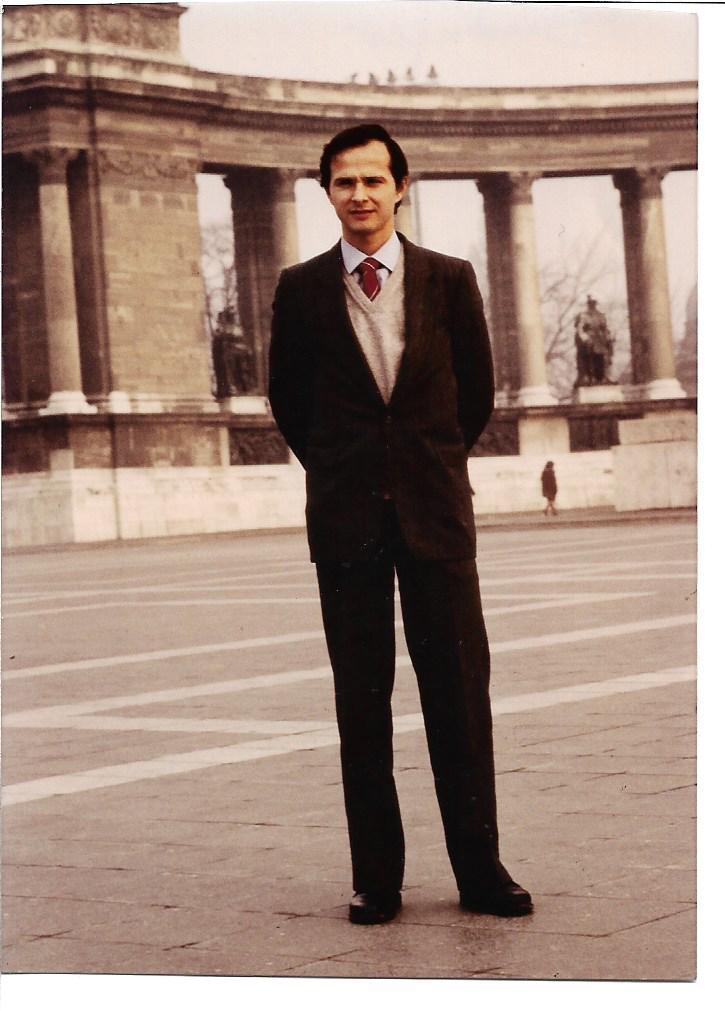
Bernard Martoïa author is a retired French Diplomat
 BarBar
Leave a Reply